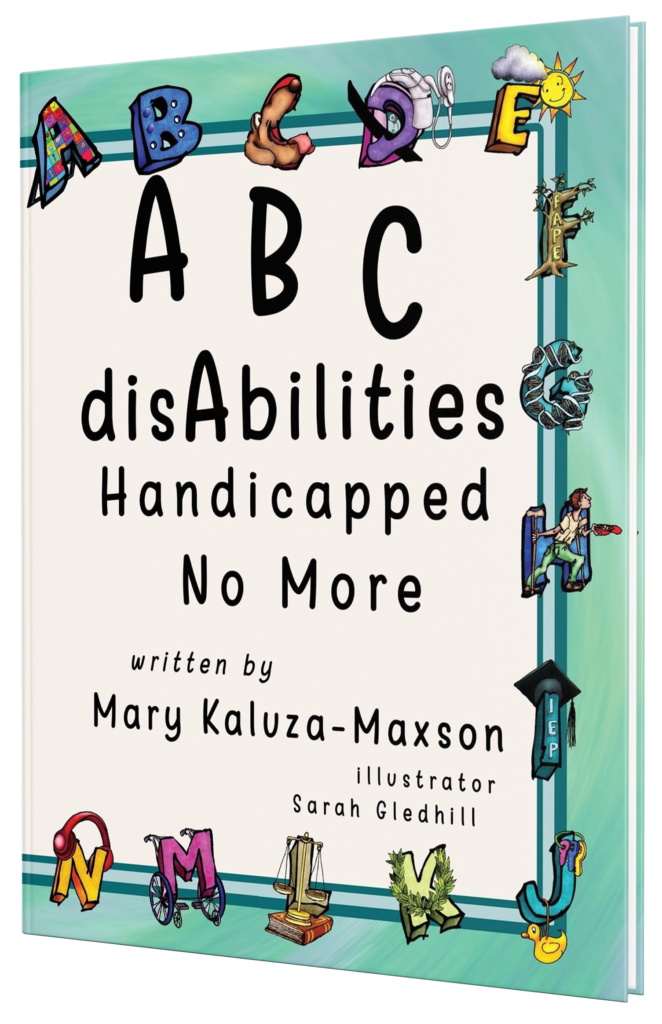
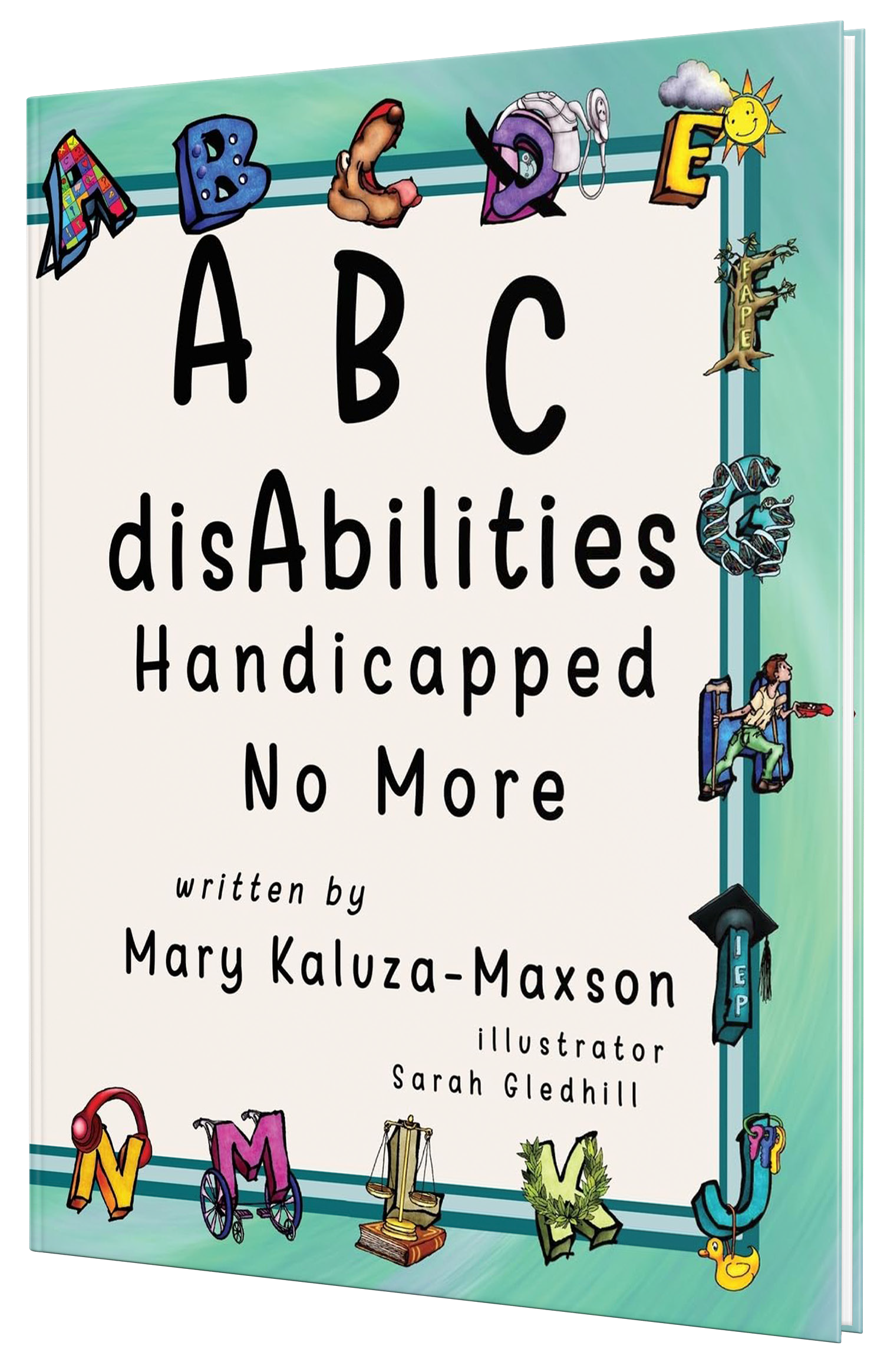
A smile is a mile of kindness which opens the way to see our similarities and not fearful of our differences. Discover your own talents and recognize the abilities in everyone by joining the Zeus Patrol from letter Z. Membership and dues are free!
There are successful Artists, Doctors, Musicians, Presidents, Zookeepers, and people from all the occupations in between, who have overcome disabilities to find great success.
Explore and gain insight with this alphabetical book A B C Disabilities, Handicapped No More.
Pages
0
Word count
0
Letters
0
author
About Mary
One of Mary’s brothers sustained Cerebral Palsy and deafness shortly after birth in the 1950’s. This began her lifelong experience with the disabled.
Mary has a B.A. in Communications from UNC Greeley, Colorado and an M.A. in Educational Administration from CSUN Northridge, California. She also has a Secondary English Teaching Credential, a Language Development Specialist Certifi cate, a Special Education Credential: authorization (PHI) Physically Handicapped Impairment which covers Orthopedic and Other Health Impairments, as well as an Educational Administration Credential.
She began her career as a preschool teacher/director. Mary then taught in the Los Angeles Unified School District as a Special Ed. classroom teacher, telephone teacher, and hospital teacher. She went on to be an O.I. Itinerant and case manager until retiring in 2017. A combined 37 years in education.
Her husband is also an LAUSD high school educator and music teacher. They have a grown-up daughter who has a Siberian Husky they frequently dog sit.
The voice balances professional credibility (37 years in education, credentials in special education and administration) with conversational intimacy. It reads like a trusted educator speaking directly to a parent or teacher, never lecturing, always guiding. This tonal balance is rare and effective—it earns trust without demanding it. The book avoids two common traps: it neither dwells in sorrow nor glosses over difficulty. Stories of struggle appear alongside triumphs, creating a tonal honesty that respects young readers’ intelligence. Children sense when adult authors are talking down to them; this book trusts them to hold complexity.
The invitation to “join the Zeus Patrol” introduces a light, almost superheroic playfulness that prevents the subject matter from feeling heavy. For children, this is developmentally astute—it gives them agency (“I can join!”) rather than positioning them as passive recipients of information. The humor and imagination woven throughout keep the reading experience alive rather than didactic.
Throughout the text, the pronoun choice matters. The book tends to use collective language (“we,” “us,” “everyone”) rather than separating disabled people into an “other” category. This subtle tonal choice reinforces the core message: disability is part of the human experience, not a deviation from it. The A-to-Z format serves the content, not just the marketing. It creates natural entry points for different ages and reading levels, making the book flexible across contexts (bedtime read, classroom resource, therapeutic tool).
— Malcolm Beltran, Independent Reviewer
The title itself—”Handicapped No More”—is a deliberate act of linguistic reclamation. For decades, “handicapped” was used as both a noun and an adjective to define people by limitation. Kaluza-Maxson takes that word and flips it into a declaration of liberation. The subtitle signals an ideological stance: disability does not equal incapacity. This mirrors broader movements in disability studies (e.g., the shift from “handicapped” to “disabled,” the social model vs. medical model debate) and positions the book firmly within contemporary discourse on neurodiversity and ability justice.
The book invites readers to “join the Zeus Patrol from letter Z,” a playful framing device that positions empathy and advocacy as free membership—no dues required. Each letter of the alphabet becomes a doorway into a different aspect of disability life: A for Autism, B for Braille, C for Canine Service Dogs, all the way through to Z, where the concept of the “Zeus Patrol” itself lives as a symbol of community care and inclusion.
The “Zeus Patrol” concept, in particular, is a brilliant piece of narrative design: it transforms the abstract ideal of advocacy into something tangible and inviting, especially for young readers. It tells children: You, too, can be part of this. You don’t need permission. Membership is free. ABC disAbilities: Handicapped No More is a standout contribution to children’s non-fiction on disability awareness. It manages to be informative without being clinical, inspiring without being naive, and inclusive without being performative. Mary Kaluza-Maxson has created a book that families will return to again and again—not just to learn, but to remember what matters most: that kindness opens doors, that difference is not deficiency, and that every person carries ability worth recognizing. Whether read for story time, classroom discussion, or personal reflection, this book leaves you feeling genuinely encouraged to see the world—and the people in it—more clearly.
— Joecel Perry, Independent Reviewer
Kaluza-Maxson’s personal history—her brother’s cerebral palsy and deafness—infuses the text with a familial lens. The book doesn’t speak only for disabled people but often speaks alongside families who are learning, loving, and advocating. This dual address makes the work especially resonant for parents navigating new diagnoses, while still centering disabled voices through the stories featured.
Rather than framing disability as something “wrong” with a person that needs fixing, the book consistently centers environmental and societal barriers. Entries on laws protecting rights, universal technology, and service dogs all point outward—to how the world can adapt—rather than inward— to what the individual lacks. This aligns with the social mode of disability championed by scholars like UPIAR and activists worldwide, making the book quietly radical beneath its gentle surface.
“A smile is a mile of kindness” is not merely a catchy phrase—it’s a thesis statement. The book positions empathy as structural, not incidental. The “Zeus Patrol” metaphor extends this: kindness is an organized, ongoing practice, a patrol you join, not a one-time gesture. This reframing is significant because it moves readers—from children to adults—away from pity toward sustained engagement. By listing Artists, Doctors, Musicians, Presidents, Zookeepers, and “all the occupations in between,” the book performs a crucial corrective: disabled people are not only present in helping professions or inspirational contexts. They populate every sector of society. This thematic choice combats the dual stereotype of disabled people as either objects of charity or supernatural overachievers—offering instead a vision of ordinary, extraordinary participation.
John Doe@username
Lorem ipsum dolor sit amet, consectetur adipiscing elit. Ut elit tellus, luctus nec ullamcorper mattis, pulvinar dapibus leo.
John Doe@username
Lorem ipsum dolor sit amet, consectetur adipiscing elit. Ut elit tellus, luctus nec ullamcorper mattis, pulvinar dapibus leo.
John Doe@username
Lorem ipsum dolor sit amet, consectetur adipiscing elit. Ut elit tellus, luctus nec ullamcorper mattis, pulvinar dapibus leo.